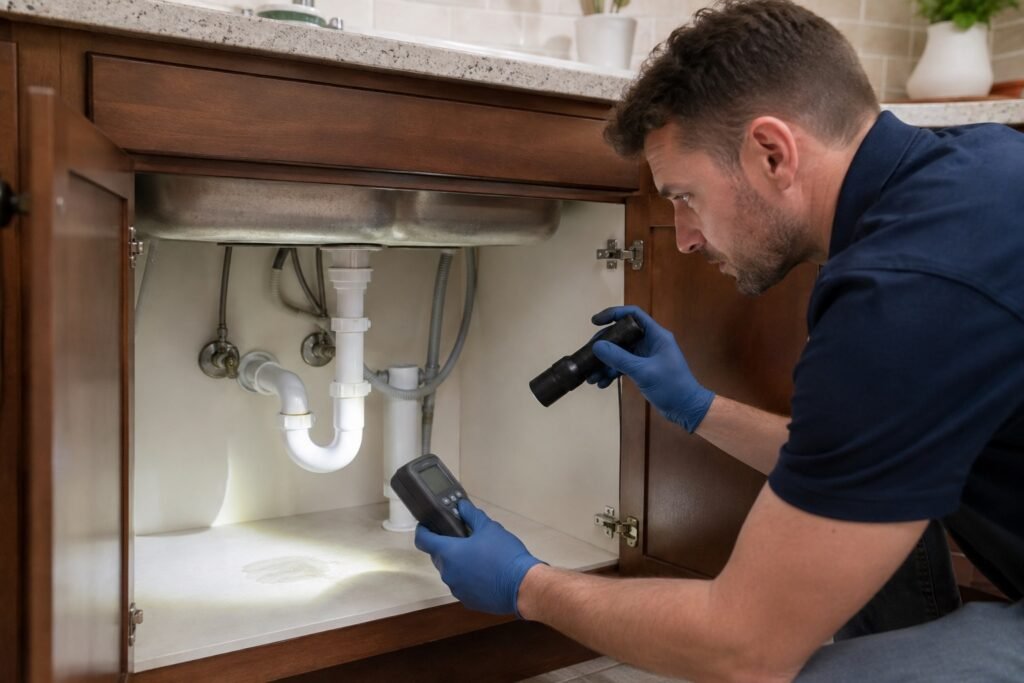
Water damage rarely begins as the dramatic flood shown in advertisements. It often starts with a slow supply-line drip, failed seal, blocked condensate drain, roof opening, or ground-water path that stays unnoticed behind a cabinet or below flooring. The fastest way to prevent mold and expensive reconstruction is to find moisture early, stop its source safely, and dry the affected materials appropriately.
The U.S. Environmental Protection Agency summarizes the principle clearly: moisture control is the key to mold control. This guide explains a practical prevention routine and the limits of homeowner cleanup. It does not replace professional assessment for contaminated water, extensive damage, health concerns, hidden growth, or affected electrical and structural systems.
Know the most common water sources
Plumbing supply and fixtures
Inspect visible connections below sinks, behind accessible toilets, at washing-machine hoses, around refrigerator water lines, and near water heaters. Look for droplets, corrosion, mineral tracks, swollen cabinet material, stained flooring, or a valve that feels damp. Do not tighten or operate a questionable fitting simply because you found it; the wrong movement can turn seepage into a break.
Drain and sewer systems
Slow drains, recurring backups, gurgling, sewer odor, or staining below a fixture deserve investigation. Drain cleaners can damage some materials, react with other chemicals, and create hazards for the plumber who opens the line. Use only products compatible with the system and label directions, and disclose anything already placed in a drain.
Roof and exterior openings
Missing roof material, failed flashing, deteriorated sealant, damaged siding, or poorly managed roof drainage can admit water far from the eventual ceiling stain. Observe roofs from the ground. Wet, steep, damaged, or high surfaces belong to trained and insured professionals.
Foundation and site drainage
Downspouts terminating beside the foundation, soil sloping toward the house, blocked drains, irrigation aimed at walls, and settlement around utility penetrations can concentrate water. Correct solutions depend on soil, foundation type, climate, property boundaries, and local stormwater rules. Avoid sending water onto neighboring property.
Heating and cooling equipment
Cooling coils remove moisture from air, and that condensate needs a clear, correctly installed path. Check for water near the air handler, rusted pans, clogged visible outlets, staining below equipment, or a repeatedly triggered float switch. Do not bypass a safety switch or open energized equipment.
Create a five-minute monthly moisture inspection
- Use a flashlight under sinks and around visible plumbing.
- Look at ceilings below bathrooms, roof valleys, and mechanical equipment.
- Notice musty odors when opening closets and cabinets.
- Check window condensation and bathroom ventilation.
- Walk the exterior after rain and observe downspout discharge and pooling.
- Compare the water bill or meter pattern with normal household use.
A low-cost humidity meter can help identify persistent conditions, but it does not diagnose hidden mold. EPA guidance suggests keeping indoor relative humidity below 60 percent where possible, ideally around 30–50 percent. Climate and equipment affect what is achievable; persistent condensation is a reason to investigate ventilation, insulation, temperature, and moisture sources.
What to do during a new leak
First protect people. Stay away from water contacting outlets, appliances, service panels, or wiring. Do not enter a flooded basement where electrical or structural hazards may exist. Leave and call emergency services, the utility, property management, or an appropriate professional when there is immediate danger.
If conditions are safe and you know the correct control, stop the water at a fixture or main shutoff. Our utility shutoff guide explains why controls should be identified before an emergency. Renters should notify the landlord or emergency maintenance line promptly and document the time and condition.
Protect unaffected belongings without spreading contaminated water. Photograph damage for records and contact the insurer when the loss may be covered. Do not discard important items until you understand documentation requirements unless keeping them creates a health or safety hazard.
Drying time matters
EPA guidance advises drying wet materials and areas within 24–48 hours where possible to reduce mold growth. That does not mean every assembly will be safely dry because its surface feels dry. Water can remain beneath flooring, inside wall cavities, behind baseboards, under cabinets, or within insulation.
Increase safe air movement and dehumidification only when the water is clean, electricity is safe, and doing so will not spread contamination. A restoration professional can measure moisture in materials and decide what must be opened, cleaned, dried, or removed.
Small surface mold versus a larger problem
The EPA says that a moldy area smaller than about 10 square feet can often be handled by a homeowner following appropriate guidance. Size is only one factor. Professional help is appropriate when:
- Water damage is extensive or repeatedly returns
- Sewage or contaminated floodwater is involved
- Mold covers more than roughly 10 square feet
- Heating or cooling equipment may be contaminated
- Growth is hidden inside a large assembly
- Occupants have health concerns
- Structural materials are damaged
- You cannot safely isolate and clean the area
People with asthma, allergies, immune suppression, or other health concerns should consult a healthcare professional about exposure and cleanup participation.
Clean the material, not just the color
For an appropriate small area, fix the water source first. EPA guidance recommends cleaning mold from hard surfaces with water and detergent and drying completely. Porous materials such as ceiling tile, carpet, insulation, or damaged composite board may be difficult or impossible to clean fully and may require replacement.
Do not paint or caulk over active mold. A coating can hide the evidence while moisture and deterioration continue. Avoid mixing cleaning chemicals, and follow product ventilation and protective-equipment instructions. Bleach is not a substitute for fixing moisture and is not appropriate for every material or situation.
Prevent recurrence room by room
Kitchen
Inspect sink connections, dishwasher edges, refrigerator supply lines, and cabinet bases. Use the range hood as designed while cooking, especially when it exhausts outdoors. Wipe spills before they enter seams.
Bathroom
Use the exhaust fan during bathing and long enough afterward to clear moisture according to its instructions. Repair loose fixtures, failed sealant joints, slow leaks, and soft finishes instead of adding repeated cosmetic layers.
Laundry
Inspect hoses and connections, keep the drain path secure, and follow appliance clearance requirements. Do not leave a running washer unattended for long periods when avoidable.
Basement and crawl space
Track humidity, foundation seepage, sump operation, plumbing leaks, and stored items touching damp surfaces. Do not enter a crawl space with standing water, pests, damaged wiring, poor air, or structural concerns.
Exterior
Keep appropriate drainage paths open, maintain roof-water systems, correct irrigation spray against the building, and address grading with attention to local rules. Our seasonal maintenance calendar helps time these observations.
Document the repair
Record the source, affected materials, photographs, moisture readings taken by professionals, cleanup method, parts replaced, drying dates, and final verification. A stain can remain after successful drying, so the record helps distinguish old cosmetic evidence from a new leak.
For a contractor, request a written scope that separates water-source repair from demolition, drying, treatment, reconstruction, and testing. Use the contractor hiring checklist and ask how the company will verify that the cause—not only the visible damage—has been corrected.
The most effective mold strategy is ordinary and repeatable: notice moisture, act promptly, dry correctly, and prevent the water from returning.