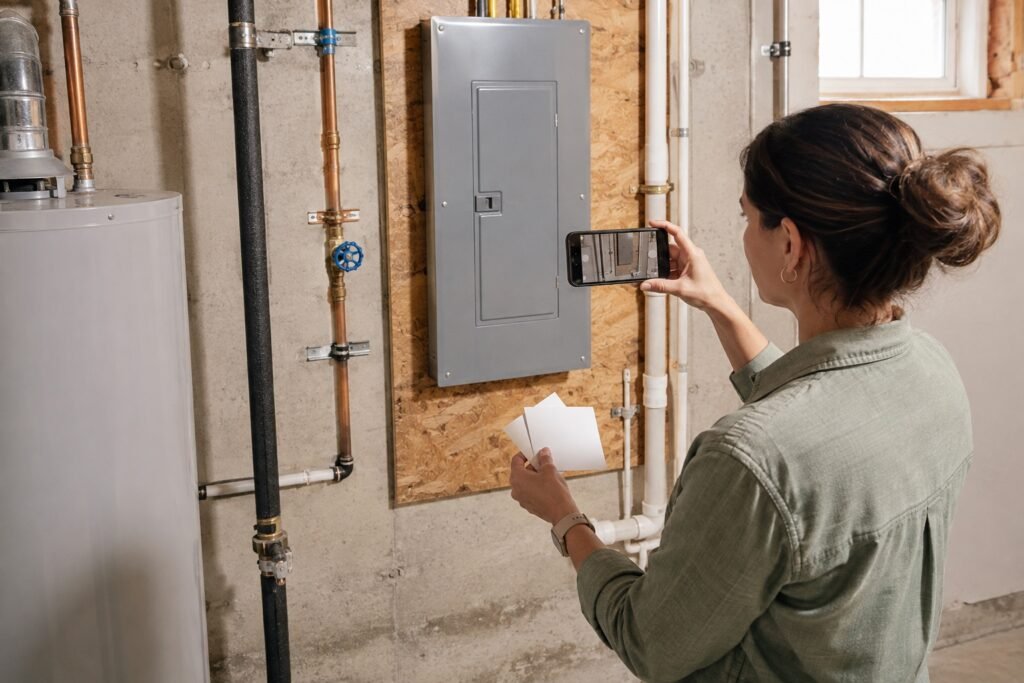
A burst supply line, overflowing fixture, electrical fault, or storm can become far more damaging when nobody knows where the home’s controls are. Every household should have a simple utility map that identifies the main water shutoff, fixture shutoffs, electrical service panel, and emergency contacts. The map is useful for owners, renters, house-sitters, and newly arrived family members who may not recognize U.S. building equipment.
This guide focuses on locating and documenting controls. It is not an instruction to operate gas equipment or open electrical enclosures. Systems vary by age, region, utility, and building type. Ask the landlord, property manager, utility, home inspector, plumber, or electrician to demonstrate anything uncertain before an emergency.
Start with records and a slow walk-through
Review the property inspection, lease, utility paperwork, and any labels left by previous occupants. Walk through the basement, garage, utility closet, mechanical room, crawl-space entrance, and exterior perimeter only where access is safe. Carry a flashlight and phone camera. Avoid moving insulation, entering a confined crawl space, standing in water, or touching equipment that appears damaged.
Create a private note for each control with:
- Its purpose and exact location
- A wide photo showing the route to it
- A close photo showing the control
- Any tool normally required
- The professional or utility that verified it
- The date it was last checked
Do not publish photographs containing account numbers, meter identifiers, security details, or a home’s precise layout.
Finding the main water shutoff
In many detached homes, the main interior water valve is located where the service pipe enters the building. Common places include a basement wall facing the street, a crawl space, utility room, garage, or area near the water heater. In warm climates, it may be in an exterior valve box or near the meter. Condominiums and multifamily buildings may have individual unit valves, shared building valves, or both.
A wheel-style gate valve and a lever-style ball valve operate differently. Age, corrosion, mineral deposits, and disuse can make either difficult to move. Do not apply a pipe wrench or excessive force to a valve simply because it looks like the main control; breaking it can turn a planning exercise into a flood. Ask a plumber to identify, test, label, or replace a questionable valve.
Also locate the smaller shutoffs serving toilets, sinks, washing machines, refrigerators, dishwashers, and exterior faucets where present. A sound fixture valve may stop a local leak without interrupting the entire home. If a small valve leaks when touched or does not close normally, leave it and schedule repair.
Understanding the electrical service panel
The breaker panel is often in a basement, garage, hallway, utility room, or exterior-rated enclosure. It should be accessible, dry, and unobstructed. Learn which panel serves your unit if the property contains more than one. Some homes have a main service panel plus subpanels.
Keep the metal cover closed. Removing the cover can expose energized components even when individual branch breakers are off. Do not touch a wet, hot, buzzing, scorched, rusty, or damaged panel. If you smell burning, see smoke, or hear arcing, move to safety and call emergency services or the utility as appropriate.
A circuit directory should describe which rooms or major appliances each breaker controls. Labels such as “lights” or “plugs” are not useful enough. A licensed electrician can correct an inaccurate directory. A homeowner can document ordinary branch circuits only when conditions are normal and a safe helper can confirm which lights or receptacles lose power; never repeatedly trip breakers, remove covers, or work on energized wiring to create the list.
Know that turning off a branch breaker does not make every conductor in a box safe, particularly in older or modified systems. Electrical repair belongs in the professional column of our DIY-versus-professional guide unless you are legally permitted, properly trained, and able to verify de-energization with suitable equipment.
Natural gas and propane: locate, but do not practice
If the home uses natural gas or propane, record the utility’s emergency telephone number and identify the meter or tank from a safe distance. Do not turn the supply off as a practice exercise. Some utilities require their personnel or a qualified professional to restore service and check appliances after an interruption.
If you smell a strong sulfur-like or rotten-egg odor, hear escaping gas, or suspect a leak, do not operate lights, switches, phones, flames, vehicles, or electrical devices in the affected area. Leave the building, move away, and contact 911 or the gas supplier from a safe location. Follow the utility’s instructions rather than returning to find a valve.
Other controls worth mapping
Heating and cooling
Identify the thermostat, equipment service switch, filter location, outdoor disconnect location, and condensate drain without opening energized compartments. The nearby switch may resemble an ordinary light switch, so label it only after a technician confirms its function.
Water heater
Record whether the unit is electric, natural gas, propane, heat pump, or another type. Identify the cold-water supply control and the professional who services the equipment. Never cap, block, or operate a temperature-and-pressure relief valve as an experiment, and do not store materials against the heater.
Sump pump and sewer equipment
If the house has a sump pump, sewage ejector, septic system, or backwater valve, learn its normal sound, power source, alarm, service schedule, and failure response. Do not assume every covered pit is a sump. Keep manuals and service contacts in the home file.
Fire suppression and shared-building systems
Sprinkler valves, standpipes, alarms, and shared condominium controls should not be operated or obstructed. Report a problem to building management or the responsible fire-protection professional.
Make a one-page household utility map
Your final map should be understandable to someone seeing the home for the first time. A useful order is:
- Emergency contacts and property address
- Main water shutoff
- Electrical panel and main disconnect location
- Gas or propane emergency contact and equipment location
- Individual appliance and fixture shutoffs
- Sump, septic, generator, solar, battery, or other special systems
Keep a printed copy in a known but nonpublic place and a secure digital copy. Tell adult household members where it is. A wrench or valve key should only be stored if the responsible professional or utility confirms the correct tool and procedure.
When moving into a rental
Ask management which controls a tenant may use and which require maintenance staff. Document any inaccessible shutoff, unlabeled panel, active leak, missing alarm, or blocked utility area in writing. Do not enter locked mechanical rooms or alter shared services.
Combine this map with the broader first 30 days in a U.S. home checklist. Revisit it after renovation, equipment replacement, or a change in occupants. The best time to learn these systems is during an ordinary afternoon—not while water is spreading across the floor.